



Avoid 'We Buy Any House' Scams & Find Out Which Cash Home Buying Companies are Safe-to-Use

The 'Quick Sale' industry is infested with sharks, scammers and fake cash buyers...
We show you how to avoid the sharks and find reliable and trustworthy cash buyers.
As recommended by:
"TheAdvisory is one those secret sources I keep close to my chest."

How the #1 Fast Cash Home Buyer Scam Works

The 4 step process [shady] cash buying companies use to rip you off
Over promise on their initial offer

Shady cash buying companies will make an unrealistic high offer and promise to get the money in your hands in a matter of days pending an official valuation.

Use delay and stall tactics

Using every delay and stall tactic in the book, these companies will drag out the process for months.

Drop price at 11th hour - when you have no choice but to accept

At the last possible moment, these companies will cut you back savagely when you’re out of time and unable to do anything other than to accept.

ALSO: Lock you into an 'Option Contract'

Some companies will also push you to sign paperwork (hoping you don't read the fine print) that prevents you from selling to anyone else.
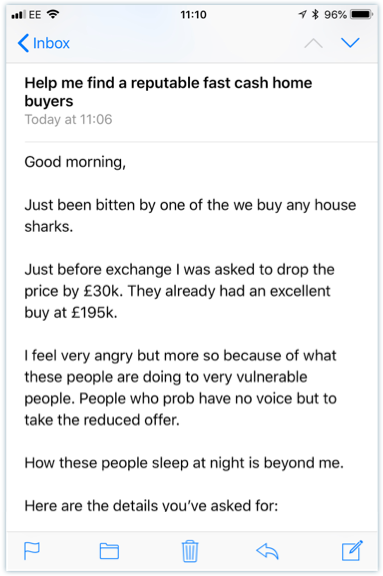
An email sent to TheAdvisory by Jane Deakin explaining how
a cash buying company tried to drop the price at the 11th hour

It gets worse:
'We Buy Any House' companies often don't have the cash to buy your home

Despite claiming otherwise, only a few companies actually have the cash on hand to buy your home and quickly solve any property related problem you’re facing. BEWARE: 97% of the companies out there are not ‘genuine’ cash buyers. The vast majority of these firms are lead generators selling your personal details or brokers passing your details on to small-time investors. They promise you the world to trick you into signing an option contract. The option contract is needed to hold you in place (i.e. stop you being able to sell elsewhere) while a buyer and/or mortgage funding is secured. This makes the process risky and your sale far from guaranteed.

Companies that buy houses for cash are NOT regulated by any government body

Anyone that claims differently is misleading you  – no one is effectively policing this space.

That’s why shady companies are able to routinely take advantage of vulnerable people trying to cope with high-stress situations.

"The [Quick Sale industry] is yet another area of the property sector where there is no formal regulatory framework.

Whilst I note that the OFT is pursuing a self-regulatory approach, the only way of realistically ensuring all such firms provide consistent service is through legislation."


Christopher Hamer
Property Ombudsman (TPO) 2004 – 2015

You can sell your home fast to a 'We Buy Any House' company without getting ripped off - we'll show you how

Protect yourself with our insider knowledge of the industry and safely navigate these treacherous ‘Quick Sale’ waters.

Keep reading to learn how to spot scammers and identify reliable and trustworthy cash buyers…

Meet Gavin Brazg

Founder and CEO of TheAdvisory - Protecting house sellers since 2005
Unofficially Monitoring the
‘Quick Sale’ Industry Since 2005

On the face of things, all ‘Quick Sale’ companies look and smell the same.

So how do you tell who the reliable and trustworthy guys are?

I’ve been asked this question by house sellers since 2005 and have monitored this sector ever since in order to provide answers.

Hi,

I’m Gavin Brazg, founder of TheAdvisory, the UK’s oldest advice and support resource for home sellers.

I’m not an estate agent but I am a serial house seller that buys and sells over 150 properties a year.

I started TheAdvisory after accidentally stumbling upon a huge appetite online (from the public) for answers to a variety of house selling questions – including problems and issues with cash house buying companies.

Coming from a land development and house building background, these were all things I knew inside out, so I wrote some articles to help answer peoples’ questions and stuck them on the web…

Hey presto!.. TheAdvisory was born.

What I didn’t foresee was how big TheAdvisory would get.

To date, TheAdvisory has been visited by over 5 million UK house sellers, and I’ve personally advised over 20,000 property owners on how best to safely sell quickly for cash.

Over this time I’ve become more than a little addicted to helping protect the public from the unethical practices found in the property industry.

I’ve also had to grow a team to help run the site. All members are also serial house sellers and veterans of the UK residential property industry.

Most started within estate agency and then moved into the corporate property sector, specialising in asset management and developer part exchange services.

As a collective we’ve been trusted to project manage over 6,000 residential property sales for the likes of HSBC Bank, Barratt Homes, Taylor Wimpey, Investec, Lloyds Bank, McCarthy and Stone, Persimmon Homes, GE Money and Aviva.

Here’s what gets us up in the morning:

  1. We love helping protect people from scams and unethical industry practices.
  2. We love sharing our insider knowledge of how to get better house selling results.
  3. We love having the opportunity to make a positive impact in peoples’ lives.
Gavin Brazg, Founder and CEO of TheAdvisory
"THE TIMES's favourite house selling expert"
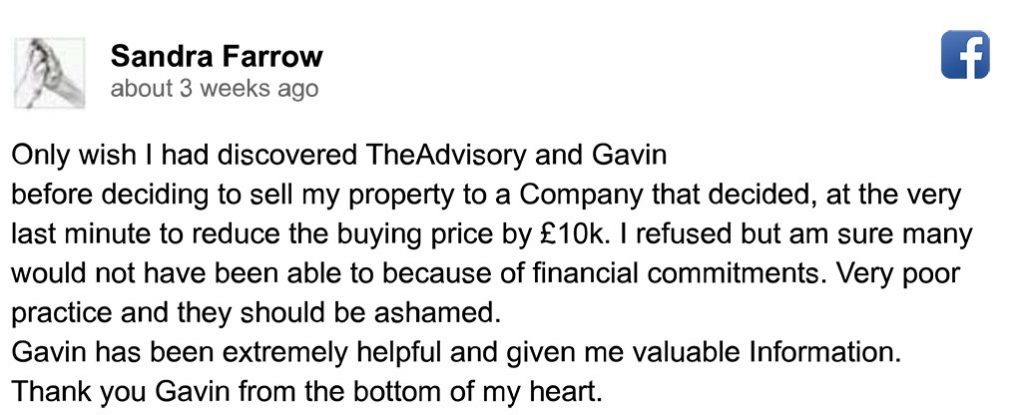
"Only wish I had found TheAdvisory & Gavin before..."

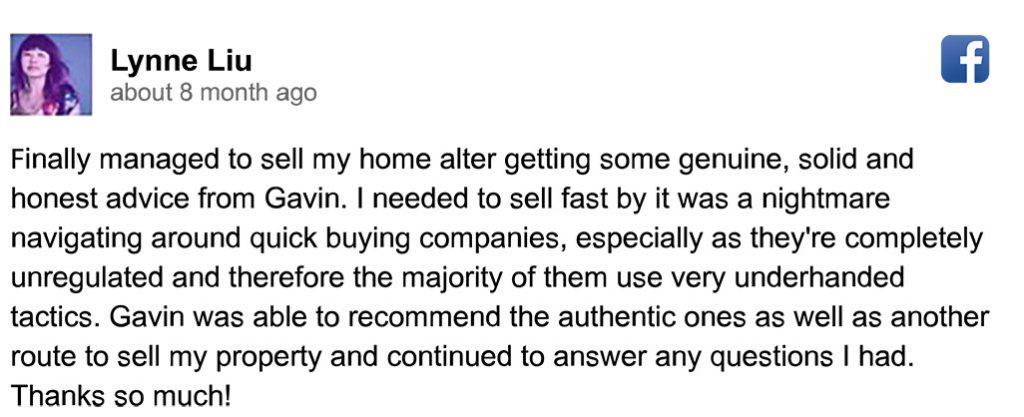
“Genuine solid & honest advice from Gavin..."

How to Spot 'We Buy Any House' Scammers vs. Trustworthy Companies

Quickly identify scams and shady practices

9 rules to protect yourself from scams

WALK AWAY IMMEDIATELY IF A COMPANY:

Asks for an upfront payment of any kind.

Asks for any cancellation or withdraw fee within their paperwork.

Asks you to sign a ‘lock-in contract’, ‘option agreement’ or ‘RX1’ form.

Claims to provide a guaranteed sale for close to 100% of market value.

Claims they (or the industry) are ‘regulated’ by a government body.

Claims they can sell your house to investors for +90% of market value.

Wants to put a 'restriction' against the title of your property with HM Land Registry.

Does not have a clearly visible Company Registration Number on their website.

Cannot provide ‘proof of cash funds’ upon your request.

INTRODUCING:
The easy way to find reliable and trustworthy ‘Quick Sale’ companies.

Get matched with reliable and trustworthy quick property buyers

We believe all ‘Quick Sale’ companies should be safe and have high ethical standards – sadly this is not the case.

That’s why we created the ADVISORY APPROVED program, a system of accreditation to highlight reliable and trustworthy companies.

You get fast access to companies that won’t mess you around or reduce their offer by £10,000’s at the last minute.

Rigorous vetting

All ADVISORY APPROVED companies have passed a rigorous 15-point vetting process.

It’s tough. 97% of companies fail.

Those that do pass are guaranteed to be reliable, trustworthy and 100% risk-free to get offers from.

How we monitor the ‘Quick House Sale‘ sector to help you find the reliable & trustworthy companies

Mystery Shop

We regularly mystery shop cash house buying companies that operate in England, Wales and Scotland.

Gather Community Reviews

We collect stories from sellers using these companies – this keeps our finger on the pulse of who is (and isn't) providing a fair service.

Verify Cash Funds

We verify that companies actually have the cash readily available to buy your home.

Trusted advice since 2005

The ADVISORY APPROVED program has been trusted by over 20,000 home sellers since 2005
"What a great service! Speedy reply and sensible honest advice."
Karan Carroll
"This has saved me a load of worry!"
Rachel Garrington
"Invaluable service and I knew exactly who not to waste my time with."
Shajna Begum
"Has saved me money, time and sleepless nights."
Anthony Herring

Our Promise to You...

All ADVISORY APPROVED companies pass the following screening criteria:
Genuine cash buyers with verified cash on hand
Won't drop offer at the last minute
Fair valuation of your property
Can have cash in your hands in 7 - 28 days
Will buy property in any condition in your location

Get Your FREE Recommendations for Reputable Cash Buying Companies

Get matched with home buying companies that are safe, easy to work with, and actually have the cash on hand to buy your home quickly.
How it works:
  1. Answer 6 quick questions about a property.
  2. You’ll get a FREE personalised list of ADVISORY APPROVED companies most likely to pay above average prices.

As recommended by:

"TheAdvisory drips in honest-to-goodness practical advice for today's house sellers”
- The Independent
GET MATCHED WITH RELIABLE & TRUSTWORTHY 'QUICK SALE' COMPANIES
  • This field is hidden when viewing the form
  • This field is hidden when viewing the form
Privacy & Security Protected.

Wary about scams?
You should be!

That's why we do what we do...
Carol Ford
Rated 5 out of 5

Google Review

Dear Gavin,

Thank you so much for expressing your sympathy and for your advice which I’ve just read through and taken note of. I spoke to your recommended companies earlier today after trying to sell my home through an NAPB member that turned out to be scammers.

Your recommended companies were in contrast very upfront and honest. I thought I’d done my research as best I could and decided to use this other company back in May.

I was shocked to see my home advertised on Zoopla when I was assured that they buy houses.

I am still waiting for one of their ‘investors’ to buy the bungalow, even though I asked specifically if they actually have the funds to buy property and was assured that they do.

I should have asked for proof of this, but didn’t. I only found your site tonight and wish I’d found it before because I tried to find as much information as possible about which companies to avoid.

Thank you so very much for helping me avoid worse trouble, because I contacted two more house buyers before finding your page.

Needless to say, I will not be speaking to them when they contact me. I cannot believe people can be so callous when they have no idea about an individual’s situation.

Once again, thanks and please carry on what you’re doing. I often think about older people without a support network and how horrible it must be for them to be scammed in any way.

What to Expect Selling to
We Buy Any House Companies

Your common questions answered...

Are 'we buy any house' companies a scam?

Genuine cash buyers aren’t a scam. But the ‘Quick Sale’ industry is full of companies that are and from the outside, they all look the same.

That’s exactly why we exist: we’re independent, we don’t buy houses and we’re not estate agents.

We mystery-shop and vet the industry, so you only ever deal with companies that have passed our 15-point ADVISORY APPROVED checks. Sadly, based on our ongoing audit since 2005, around 97% of advertised cash buyers aren’t genuine.

Here are the 5 tricks the shady ones use to catch sellers out – then we’ll show you exactly how to spot a safe one.

1. They drop the price at the 11th hour (‘chipping’)

The oldest trick in the book. They agree a price, you get committed… then days before completion
they slash the offer knowing you’re out of time and can’t walk away. The industry calls it
‘chipping’ or ‘gazundering’. We call it what it is: underhand and exploitative.

2. They lock you in with an ‘option agreement’

Instead of buying, they tie you into an ‘option’ or ‘exclusivity’ contract (i.e. a bit of contract
that stops you selling to anyone else while they go looking for a buyer). Sign one and you’re trapped
for months.

3. They deliberately undervalue your home

Some use their own tame surveyors to value your property low, so they can pay you a fraction of
what it’s worth. A genuine buyer pays 75–82% of market value. Anyone paying noticeably less is
short-changing you.

4. They sting you with hidden fees

A genuine buyer covers every cost. The shady ones add a ‘valuation’, ‘admin’ or ‘refundable’ fee
that comes straight off your final figure or simply pocket it upfront and walk. Steer clear of
anyone asking for an upfront payment of any kind.

5. They aren’t buyers at all – they just sell your details

Plenty of ‘we buy any house’ sites don’t buy a single house. They’re lead generators: they collect
your details and sell them on to whoever’s paying. You think you’re talking to a buyer when really,
you’re personal details are being sold into a marketplace of random property investors.

When should I consider selling to a cash buying company?

Only when your need to move is greater than your need to sell for the best possible price.

Then, and only then, is this route worth exploring.

It fits situations like; repossession, divorce, probate, a broken chain, an inherited or empty property, or relocating to a deadline.

Cash buyers will also buy in any condition (including run-down), unmortgageable or short-lease properties a normal buyer can’t or won’t touch.

But with time and a moving market on your side, you’ll almost always net more through a well chosen local estate agent.

How quickly can genuine companies buy my house for cash?

A reputable and professional cash homebuyer will be able to buy your house and put cash in your bank account within 7 – 28 days.

Many claim they can do this in 24 hrs but in reality, there are only one or two specialists that have the resources to make this happen.

If you have the misfortune to end up dealing with a less than a genuine buyer, expect the process to be drawn out for months as they try to secure finance or find you a buyer.

How much do "we buy any house" companies pay?

“In the 20 years I’ve audited the UK quick-sale industry, genuine ‘we buy any house’ companies
have consistently paid around 75–82% of market value in return for a guaranteed sale
in 7–28 days.

Be sceptical of any firm advertising ‘up to 85%, 90% or even 100%’ – the words ‘up to’
are deliberately chosen to mislead, and in my experience any offer above 82% should be
treated with suspicion
: it’s the classic bait, followed by a last-minute price cut just
before completion.” –
Gavin Brazg, Founder, TheAdvisory

On an average UK home (around £268,000), a genuine offer works out at roughly
£200,000 – £220,000. That is the true cost of fast and guaranteed sale. 

Be wary of adverts like this:

Misleading advert to buy your property for cash at 100% market value

Anyone claiming to pay 85%, 90%, 95% or 100% is NOT offering a ‘guaranteed’ cash
purchase of your property. They are offering to ‘sell’ your property (not to ‘buy’ it).

If a claim sounds too good to be true… it is.

How do I check if a quick-sale company is legitimate?

Start with the warning signs. A genuine company can show you proof of cash funds on request, never asks for a penny upfront, and won’t tie you into a lock-in contract or claim to be ‘regulated’ (because the industry isn’t).

Our 9 rules to protect yourself from scams (see above) cover every red flag worth walking away from.

But the fastest, safest check is to skip the guesswork altogether: before you commit to anyone,
see which companies in your area have passed our 15-point vetting.

Every ADVISORY APPROVED company has been mystery-shopped, had its cash funds verified, and cleared all 15 checks. Based on our audit, around 97% of companies don’t. It’s free, and it means you only ever talk to firms already proven safe.

Is the quick house sale industry regulated?

No — it’s completely unregulated. And the reassuring badges on company websites are worth far less than you’d think.

After an Office of Fair Trading study in 2013 recommended the sector regulate itself, the National Association of Property Buyers (NAPB) was set up, with members agreeing to sign up to The Property Ombudsman (TPO).

You’ll see both logos everywhere, dressed up as a stamp of safety.

The problem: Neither body can actually protect you.

Don’t take my word for it – take theirs. The Property Ombudsman states plainly that it
“is not a regulator”, with no power to fine firms or take legal action against them. The NAPB is blunter still, describing itself as “not in itself a redress scheme or regulator”.

The two organisations lending this industry an air of respectability openly admit they have no teeth.

And only around 49 firms are NAPB members in the first place – a tiny slice of an
industry of hundreds – so most companies you’ll deal with sit outside even this toothless system. Estate agents, by contrast, are tightly regulated by law. Quick-sale sellers get none of that.

Here’s the clincher: the commonest trick of all – agreeing a price, then slashing it days before completion – is perfectly legal, because an offer isn’t binding until contracts exchange. No rule stops it.

The Ombudsman can, in theory, award a wronged seller up to £25,000 but only against one of its handful of members, and only after the damage is already done.

The takeaway is blunt: you’re on your own when you swim with the Quick Sale sharks. And that’s why we continue to monitor this industry so closely – to help you identify the genuine and trustworthy operators.

Are all 'we buy any house' companies the same?

No, they’re not. From the outside they look identical – same promises, same adverts, same ‘we buy any house’ line – but underneath they fall into four very different types, and only one actually buys your home with its own money.

This isn’t just my opinion. When the Office of Fair Trading (the government’s consumer watchdog at the time) ran the only official study of this sector back in 2013, it found the same split.

So here’s who’s who, and how to tell them apart.

1. Genuine cash buyers – the only ones you really want

These companies buy your home directly, with their own cash sitting in the bank. They’re the only
type that can truly guarantee a fast, certain sale because nobody else has to be found, chased or
financed.

A genuine buyer pays 75–82% of market value and can prove the cash is there. Ask them yourself, real buyers can show you proof of money in their actual bank account.

But here’s the sobering part: in our ongoing audit, only 3% of the companies advertising cash home buying services are genuine, ‘own-cash’ buyers.

The other 97% are one of the three types below.

2. Borrowed-money buyers. They look genuine, but they’re not

These are the trickiest to spot: Companies that genuinely buy your home themselves – so they’ll happily say “yes, we’re the buyer” – but with money they’ve borrowed from private-equity
backers, not their own cash.

They’re not con-artists. But they’re a weaker bet than a company that controls and owns its own cash.

Here’s why:

  • They can’t pay you as much. Borrowed money costs interest, and the backer wants a
    cut. To make the numbers work, they have to offer you less than someone using their own cash.
  • The money isn’t theirs to hand over. Completion depends on their backer releasing the funds on time. If the backer delays or pulls out, your sale stalls and you’re back to square one.
  • The funding can disappear. These facilities come with caps and conditions. If the
    backer tightens up or hits its limit, the money for your purchase can be withdrawn through no fault of your own.
  • It fuels last-minute chipping. The backer lends against your house, so if their valuation comes in low, the buyer is forced to chip your price near completion to make it add up.
  • You won’t see the risk coming. One backer often funds dozens of purchases at once. If they hit the brakes after a bad quarter, every sale in the pipeline (yours included) can freeze.

Remember this: ‘proof of funding’ is NOT ‘proof of funds’. A genuine buyer shows you cash in the account today. A borrowed-money buyer can only show you a conditional agreement from their backer. Big difference.

3. Brokers – they don’t buy, they ‘introduce’

Brokers don’t buy your home at all. They find a third-party investor to buy it, and pocket a fee or the gap between what the investor pays and what they offered you.

Because they have to find you a buyer, they have far less control, and your sale is far less certain.

In law, brokering is usually estate-agency work, so a legitimate broker has to be signed up to a redress scheme like The Property Ombudsman. If they’re not – walk away.

The giveaway: They mention a ‘list of investors’, talk about ‘assigning’ your agreement, or start marketing your home (on Rightmove or Zoopla). A genuine buyer never puts your house on the open market (before they have purchased it from you).

4. Lead generators – they don’t buy or sell anything

These aren’t house-buying companies at all. They don’t buy and they don’t sell. They simply collect your details and sell them on as ‘leads’ to other firms, who then call you.

You can get passed round three
or four companies, none of which are likely to have  the cash to buy your home.

The giveaway: vague talk about ‘passing on your details’, and the same identical webform across a dozen unbranded sites.

One company, a dozen names

Here’s a sneaky one to watch for: a single operator will often trade under several different brand
names. So the ‘three companies’ you carefully compared can turn out to be the same outfit wearing
different hats. Three quotes mean nothing if they all lead back to one firm.

So how do you tell which one you’re dealing with?

Most of them advertise as if they’re genuine buyers. They’re not and based on our audit since 2005, around 97% of advertised cash buyers aren’t genuine.

The one that catches people out almost every time is the borrowed-money buyer. To the untrained eye they look and smell exactly like a genuine cash buyer. Same confidence, same promises, same “yes, we’re buying it ourselves”.

Their weaknesses simply don’t show on the surface; it takes a few very specific questions to flush one out.

So before you trust anyone, ask these three:

  1. “Are you buying my house yourself, or finding someone else to buy it?” – flushes out the
    brokers and lead generators.
  2. “Is it your own cash, or are you borrowing it to complete?” – flushes out the borrowed-money buyers.
  3. “Can you show me proof the funds are in your account right now?” – a genuine buyer says
    yes without hesitation.

Anyone who dodges the questions, or offers only a ‘funding agreement’ instead of proof, isn’t the safe pair of hands they’re pretending to be.

Or skip the detective work entirely. Every ADVISORY APPROVED company has had its cash funds verified and passed all 15 of our checks – so you only ever deal with the genuine article.

— Gavin Brazg

How does selling to a cash buyer actually work (and where does it go wrong)?

A genuine cash purchase runs through seven stages, usually 7–28 days from enquiry to money in your account. But after 20 years monitoring this industry, I can tell you the process itself is where the shady companies trip you up.

So here’s each stage – and the warning sign to watch for at it.

  1. Enquiry & initial offer. You share a few details and get a provisional figure, often within 24–48 hours. A genuine buyer gives you a realistic number and says up front that it’s provisional. ⚠️ Watch for: an eye-watering “up to 100%”, or a plausible-sounding “80–85%”, dangled to out-bid the honest firms and hook you in. Remember – Whoever offers the most on the phone usually pays the least at completion.
  2. Valuation. Usually a desktop valuation plus a local agent appraisal, sometimes a RICS surveyor. A genuine buyer works from an evidence driven assessment of open-market value. ⚠️ Watch
    for:
    be skeptical of any company that won’t share their valuation evidence.
  3. Formal offer. A firm, written offer. A genuine buyer’s offer holds, and only ever moves for a real, evidenced legal or structural problem. ⚠️ Watch for: vague conditions and wiggle-room wording that leave the door open to drop the price.
  4. Solicitors instructed. Both sides appoint conveyancers. A genuine buyer pays your legal costs and is happy for you to use your own solicitor. ⚠️ Watch for: a firm that insists you use their  solicitor, or pushes a lock-in / option contract that stops you selling to anyone else.
  5. Searches & enquiries. The standard conveyancing checks. ⚠️ Watch for: an attempt to register a restriction (an “RX1”) against your title, or an option agreement – both quietly trap you and are very hard to undo.
  6. Exchange of contracts. The sale becomes legally binding and your completion date is fixed. ⚠️ Watch for: this is the classic “chipping” moment (the 11th-hour price cut), sprung when you’re committed and out of time. A genuine buyer exchanges at the price you agreed.
  7. Completion. The funds land, ownership passes the you get paid. A genuine buyer completes on the date agreed. ⚠️ Watch for: “delays” and stalling that  drag on without good explanation. Often the culprit is a borrowed money buyer waiting on its backer to release funds – the very finance delay you were trying to avoid.

The pattern to remember: a genuine company’s offer barely moves from valuation to completion. A shady one’s offer is a moving target – drifting down at every stage where it’s hardest for you to walk away.

In our 2026 seller survey, 76% of sellers told us a company had tried to chip their price at the last minute – so this isn’t a rare risk, it’s the norm with the wrong company.

Cash buyer vs auction vs estate agent - Which is really best for you?

There’s no single best route. Anyone who tells you otherwise is selling something.

What’s best for you comes down to two questions: how fast must you move, and how much equity will you trade for certainty?

Below are all the real options, including the ones most comparisons skip, each with the catch people miss.

RouteTypical speed% of market valueCertaintyThe catch most people miss
Genuine cash buyer7–28 days~75–82%HighYou trade roughly a fifth of your value for speed and certainty — only worth it if your deadline is real
Sole estate agentMonths~95–100%Low (chains break)Slowest route; the right agent matters far more than the cheapest fee
Multi-agencyWeeks–months~95–100%MediumHigher fee, but agents compete — often the fastest route to full price
Traditional auction6–10 weeksVariable, often below marketMediumA low guide price is set to attract bidders — and a failed lot poisons the offers you get afterwards
Modern method of auction4–8 weeksBelow marketMediumSold as “no fees to you” — but the buyer pays a hefty fee that quietly suppresses what they’ll bid
Assisted saleVariesVariableLowComplex — you can stay legally exposed while a third party renovates and re-sells

My honest advice? If you have time, and your home is mortgageable, don’t use a cash buyer at all. You’ll net far more with a good local agent. Better still, put two agents in competition on multi-agency terms.

A cash buyer only earns its discount when speed and certainty matter more than price.

That means a hard deadline, a broken chain, a repossession clock, or a property no ordinary buyer will touch.

Two things a table can’t show you. First, what a cash buyer really sells is certainty. That’s worth more than it sounds, because a “sold” sign is no guarantee. Our 2026 seller survey found that 24.2% of sellers, almost one in four, had a sale collapse before completion.

Second, a traditional auction gives you one protection even a cash buyer can’t. The moment the hammer falls, your buyer is locked in. Contracts exchange there and then, and if they walk away they lose their deposit and face legal action.

A cash buyer, by contrast, can still chip your price right up to exchange.

The catch with auction: it’s a public sale, not a private one, and it carries set-up, marketing and auctioneer fees. Plus, once you fail going down the auction route, that failed sale is going to negatively effect what a cash house buying company will now pay.

So don’t ask “which is best?” Ask two simpler questions. How tight is my deadline? And how much of my equity am I willing (and able) to trade for certainty?

Your answers point straight to the route that will be right for you. A league table can’t make that call. Your circumstances do.

Quick-sale jargon, explained

Cash buyer
A cash buyer is a company (or person) buying with funds already in hand, no mortgage required – so the sale can’t fall through on financing.
Proof of funds
Proof of funds is documentary evidence that a buyer actually holds the cash to buy your home – such as a current bank statement or a solicitor’s written confirmation. A genuine buyer provides it on request; an inability to is a red flag.
Chain-free
Chain-free means the buyer has no property of their own to sell first, so your sale doesn’t depend on a chain of other transactions completing.
Option agreement
An option agreement is a contract that gives a company the right to buy your home (often within a set period) without obliging them to. It’s frequently mis-sold as a confirmed cash purchase – treat it with caution.
Lock-in / tie-in contract
A lock-in (or tie-in) contract is an agreement that stops you selling through anyone else for a set period, trapping you with one company. A genuine cash buyer doesn’t need one.
RX1 restriction
An RX1 restriction is a notice a company can register against your property’s title at HM Land Registry, which can interfere with your ability to sell or remortgage. You shouldn’t need to grant one to get a cash offer.
Sale-and-rent-back
Sale-and-rent-back is an arrangement where you sell your home and rent it back from the buyer. It’s FCA-regulated, and after a 2012 review found most deals were unaffordable or unsuitable, the legitimate market effectively closed – no firms are authorised to take on new sale-and-rent-back business. In practice, anyone offering it to you today is almost certainly acting illegally, so steer well clear.
Exchange vs completion
Exchange is the point at which contracts become legally binding; completion is when the money changes hands and ownership transfers. A genuine quick sale can run both within days.
Indemnity insurance
Indemnity insurance is a policy that covers the risk of skipping certain property searches, allowing a sale to complete faster.

How do I get a conservative estimate for how much my property is worth?

The easiest way is to talk to a couple of local estate agents and ask them:

If I give you 6 weeks to sell my house, what price could you definitely secure a buyer at?

The question above encourages agents to give you a more considered estimate of open market value (as opposed to the usual deliberate overvaluation used to impress and win new clients).

Are there any other costs to expect selling to a reputable house buying company?

The reputable firms we’ve identified in the market do not charge any fees, and most also pay your legal fees (although that is deducted from their offer price).

But beware…

There are a number of ‘we buy any home type companies’ that will make you a verbal offer, but then insist you pay an inflated price for their surveyor’s valuation (anywhere from £200 – £600) before they’ll put an offer in writing.

They will usually phrase it as a ‘refundable payment for valuation’ which sounds fine – it’s ‘refundable’ after all.

However, because the money is only refunded if you accept their offer, this system is wide open to abuse.

Companies can pocket a quick £200 by making you a strong verbal offer and then lowering it after you’ve paid for the valuation.

Do that a couple of times a day and you have a business that doesn’t even need to buy any property to be profitable.

Steer clear of any home buying service that asks for an upfront payment of any kind.

Also, steer clear of any home buying service asking for any withdrawal or cancellation fees of any kind (even if they are waivered should the buyer reduce their price).

Can I still sell to a property buying company if I'm on the market with an estate agent?

Yes, but…

Whether or not you’ll have to pay your estate agent a fee will depend on what type of estate agency contract you’ve signed.

Check your estate agency contract to see if it’s either a SOLE AGENCY agreement or a SOLE SELLING RIGHTS agreement (your contract should be clearly labelled).

If it’s SOLE SELLING RIGHTS then I’m afraid your agent will be within their rights to claim a fee.

It it’s SOLE AGENCY then your estate agent will not be able to claim a fee.

Should I try to sell via auction before approaching cash house buyers?

If you need a guaranteed sale, think very carefully before you choose auction over a reputable fast house buying company.

You only get one chance to get it right – here’s why:

  1. The big problem with auctions (especially online auctions) is that your property is publicly advertised with a low guide price on Zoopla & Rightmove.
  2. If your property fails to sell, house buying companies will use your low guide price as a starting point for calculating their offers.

Bottom Line: Cash offers from house buying companies get reduced by £1,000’s after a failed auction attempt. 

Get Your FREE Recommendations for Reputable We Buy Any House Companies

Get matched with home buying companies that are safe, easy to work with, and actually have the cash on hand to buy your home quickly.
How it works:
  1. Answer 6 quick questions about a property.
  2. You’ll get a FREE personalised list of ADVISORY APPROVED companies most likely to pay above average prices.

As recommended by:

"TheAdvisory drips in honest-to-goodness practical advice for today's house sellers”
- The Independent
GET MATCHED WITH RELIABLE & TRUSTWORTHY 'QUICK SALE' COMPANIES
  • This field is hidden when viewing the form
  • This field is hidden when viewing the form
Privacy & Security Protected.

FAQs

A little more about our free recommendation service​
Frequently Asked Questions
✅Are there any legitimate cash property buying companies in the UK?

Yes (a few).

There are only a handful of genuine cash buying companies in the UK that have the funds to purchase your property, and won't drop the price at the last minute.

If you need the services of one of these companies, the main problem you face is knowing how to identify the ‘good guys’ from the scammers.

Through TheAdvisory you can get (for free) a list of vetted house buying companies that are genuine cash buyers with a long track record of reliability and honesty.

✅Is this really a free service?

Yes.

This service is 100% free and we will do everything we can to always keep it that way.

✅What are the top 10 reasons people contact cash house buying companies?

1. Struggling to sell with Estate Agents.
2. Inherited property to sell.
3. Buying another property.
4. Relocating (in UK).
5. Moving to be near family, or to be a carer.
6. Divorce/separation.
7. Empty property they need to sell.
8. Financial difficulty.
9. Facing repossession.
10. Emigrating.

✅Is TheAdvisory unbiased?

Absolutely not!

Sadly we know (and have seen) too much to be unbiased about house buying companies.

We hold very strong opinions about who the good guys are in this industry, and who the bad guys are.

Although we will never publicly ‘name and shame’ the bad guys (or talk negatively about any individual company for that matter), we will go out of our way to help promote the good guys.

We make no apology for this.

Our priority is you and making sure you have easy access to ‘safe-to-use’ companies that we are able to endorse with 100% confidence.

That’s why with TheAdvisory you get strong opinions, rigorous research and the same advice we’d give family and friends.

✅Are cash house buying companies regulated?

No.

This industry is not regulated and so you should be very suspicious of anyone that claims to be.

Have no fear, if you follow our 8 golden rules, you'll protect yourself from all the most common scams.

Plus, if you want a second opinion on anything, we're here to help and always happy to share our expertise freely.

✅Why should I get an offer from an ADVISORY APPROVED buyer?

If you are thinking of selling your property to a company that will pay cash, there are many marketing scams, and unreliable (or fake) cash home buying companies you want to avoid.

Because it’s such a minefield, we set up this free service to enable you to quickly (and safely) evaluate whether selling to a cash house buying company is right for you.

All ADVISORY APPROVED companies have passed our rigorous 15-point screening process meaning you can relax safe in the knowledge they’re genuine, reliable, and 100% risk-free to get offers from.

✅Does TheAdvisory get a fee?

To keep this service free for you, we’ve recently started to explore this option.

Most (but not all) ADVISORY APPROVED companies have started to pay us a small fee when you request an offer from them.

These fees help us:

  1. Keep the lights on so we can continue to research and vet cash house buying companies.
  2. Publish and promote insider guides to help house sellers avoid costly scams.

IMPORTANT: This arrangement doesn’t cost you a penny.

In fact, it gets you a better offer.

That’s because the fee these companies pay us is much less than their standard marketing costs (i.e. TV, press & online advertising) to reach potential clients like you.

They pass on the savings to you in the form of a better offer.

Everybody wins!

✅Does getting a fee influence who we recommend?

No.

We are regularly contacted by companies offering to pay us for our endorsement.

However, companies cannot buy ADVISORY APPROVED status – they have to be invited.

Companies are only invited if they’ve passed our 15-point vetting process and we’d be willing to recommend them to family and friends.

What’s more, ADVISORY APPROVED companies are continually monitored and must maintain standards or lose our endorsement.

✅How is my personal information protected?

All connections to and from our website are encrypted using Secure Socket Layer (SSL) technology.

Read our privacy policy for our privacy and security practices.

✅Can I get your feedback on an offer I have received?

Yes. Email Gavin Brazg (info@theadvisory.co.uk) with as many details as possible. You will usually get a response within 48 hours.

✅What is your 15 point vetting process?

Companies recommended by TheAdvisory meet the following criteria:

  1. Been actively trading for at least 5 years.
  2. Do not have a reputation for reducing their offers at the last minute.
  3. Do not charge valuation fees or withdraw fees.
  4. Provide 100% risk-free offers (i.e. No fees, no obligation, no paperwork to sign and do not tie you in).
  5. Do not ask you to sign a ‘lock in’ contract (which effectively traps you for months), or ‘tie-in’ document (which discourages you from speaking to other companies), or try to lodge any charges against your property with HM Land Registry.
  6. Purchased more than 250 properties with and have a minimum of one-hundred 4/5 star verified reviews on independent 3rd party platforms (e.g. Google, Facebook, TrustPilot).
  7. Will directly purchase your property (depressing side note: Many of the ‘Quick Sale’ companies you’ll find on the web are ‘fake’ cash house buyers – they don’t have any money, they are just looking to sell your personal details).
  8. Not reliant on 3rd party funding / bridging finance. (i.e. They have access to +£5m ready cash making their house buying service more secure and more flexible than companies reliant on 3rd party funding / bridging finance).
  9. Able to purchase freehold property in as little as 48 hours (if needed).
  10. Able to offer quick exchange with a delayed completion or license to occupy (if needed).
  11. Able to buy unmortgageable property.
  12. Do not claim to be able to sell your property to a database of investors for +90% of market value.
  13. Do not claim to be ‘regulated’ by a government body (the industry is not regulated).
  14. Consistently generate positive feedback from TheAdvisory visitors.
  15. Have a positive reputation amongst other industry insiders for ethical and honest business practices.